

At the published 0.26% gold rate, you need about 267 cases for a 50% chance of at least one knife or pair of gloves, and about 885 for 90%. The well-known "1 in 385" is only the average gap between gold items. At 385 cases you have roughly a 63% chance of having hit one, and past misses never make the next case more likely to pay.
What are the official CS2 case opening odds?
Every standard Valve weapon case uses the same five-tier ladder, and knives and gloves sit at the very bottom. Valve published the rates through its Chinese partner Perfect World in 2017, after China's Ministry of Culture required loot box odds to be disclosed. Sources tracking community openings report that the rates have stayed the same from CS:GO through CS2.
| Rarity | Colour | Chance per case | Roughly 1 in |
|---|---|---|---|
| Mil-Spec | Blue | 79.92% | 1.25 |
| Restricted | Purple | 15.98% | 6 |
| Classified | Pink | 3.20% | 31 |
| Covert | Red | 0.64% | 156 |
| Rare Special (knife or gloves) | Gold | 0.26% | 385 |
These are the 79.92%, 15.98%, 3.20%, 0.64% and 0.26% figures from the original disclosure. Everything below uses the 0.26% gold rate.
Note: These are Valve's rates for official Steam cases. CSDROP case pages list their own item pool and drop rates before you open, so check the case you plan to open instead of assuming 0.26%.
How many CS2 cases until you hit a knife or gloves?
You need about 267 cases for a coin-flip chance and 1,151 for 95%. The chance of at least one gold item in n openings is 1 − (1 − 0.0026)^n.
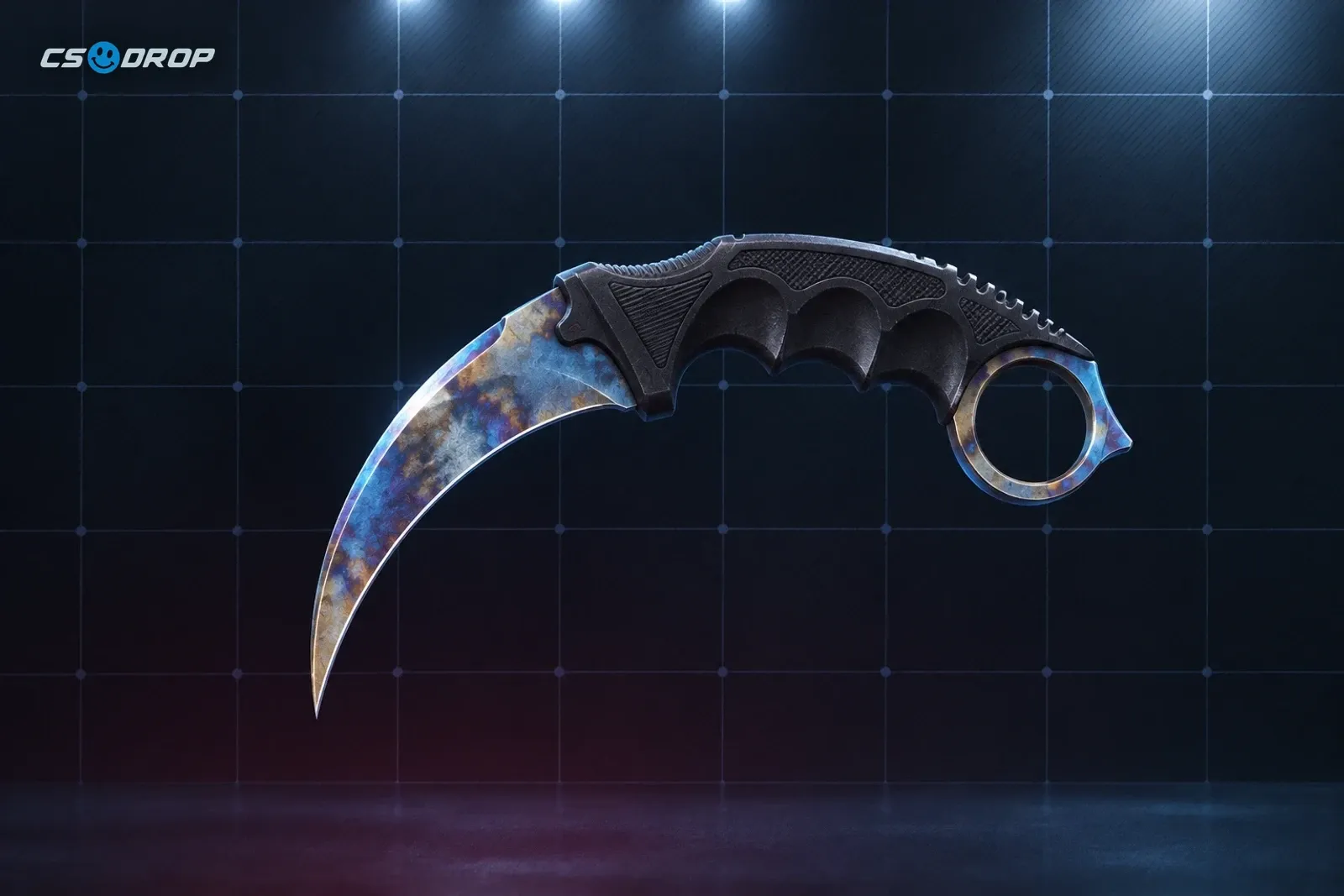
The last column below is the key cost alone. At $2.49 per key, 385 openings come to about $958.65. That is a snapshot as of October 2026 in USD, and regional prices vary. It excludes the price of the case itself.
| Chance of at least one gold item | Cases needed | Key cost alone |
|---|---|---|
| 25% | 111 | $276 |
| 50% | 267 | $665 |
| about 63% | 385 | $959 |
| 75% | 533 | $1,327 |
| 90% | 885 | $2,204 |
| 95% | 1,151 | $2,866 |
| 99% | 1,769 | $4,405 |
To run your own numbers, use n = ln(1 − P) ÷ ln(1 − p). P is the chance you want and p is the gold chance per case. As a shortcut, 50% needs about 0.69 ÷ p cases, 90% about 2.3 ÷ p and 95% about 3.0 ÷ p. Use this if a case page shows a different gold rate.
Does 1 in 385 mean a knife by case 385, or is one "due"?
No to both. 385 is an average of a very wide spread, and the typical (median) wait is shorter, at 267 cases. The standard deviation of the wait is about 384 cases, as large as the average itself.
If many players each open exactly 385 cases, this is roughly what happens:
| Gold items after 385 openings | Share of players |
|---|---|
| None | about 37% |
| Exactly one | about 37% |
| Two or more | about 26% |
More than one player in three goes the full 385 without gold. About one in four gets two or more. Both outcomes come from the same 0.26%, and neither means anything is rigged.
Nothing is "due" either. Every case is a fresh roll, and past cases do not change the next one. There is no pity timer. After 999 misses, case 1,000 is still 0.26%.
The confusion comes from two different questions:
- Before you start: 1,000 openings give about a 92.6% chance of at least one gold item.
- After a streak: the next single case is still 0.26%, however many misses came before it.
Dry streaks are normal. About 27% of players go 500 cases without gold, about 7% go 1,000, and about 2% go 1,500.
Key takeaway: Plan around the spread, not the average. The average gold item takes 385 cases, but the 50% point is 267, and a real share of players pass 1,000 with none.
How big a sample do you need to trust results?
Far bigger than most streams or case videos. In 100 openings you expect 0.26 gold items, and the chance of at least one is only about 22.9%. Seeing none tells you almost nothing.
Short samples also distort what you see. If 10,000 people each open 10 cases, about 2.6% of them (roughly 257 people) hit gold. Those are the clips that get posted, and the other 9,700-plus people stay quiet.
To test the rate itself you would need thousands of openings. At 10,000 openings you expect about 26 gold items, with a typical range of roughly 16 to 36. A hot or cold run on one account is not evidence about the odds.
What does hunting a knife actually cost?
On average, about 385 times the cost of one opening, which is the case price plus a key. Most of that spend comes back as lower-tier skins, but the total is normally less than you put in. One skin-site estimate puts the average loss at 30–70% of what you spend. The figure varies by case and by the day's prices.
Selling a drop on the Steam Market costs you more again. Steam adds its 5% fee and the game's 10% fee on top of the amount you receive, so about 13% of the buyer's price goes to fees. On CSDROP, items you win are credited to your balance at market value, and each case page shows its price and drop rates before you open.
If you want one specific knife, buying it directly is usually cheaper than chasing it. Since October 2025 there is a second route as well. Players can hand over five Covert rarity items in exchange for a knife or gloves. That route has no 0.26% roll, but the inputs cost money too. CSDROP also has an upgrader.
Do StatTrak and a specific knife change the maths?
Yes, and sharply. Any item that can be StatTrak has a 1 in 10 chance of coming with it. A StatTrak knife is therefore 0.026%, and gloves can't be StatTrak.
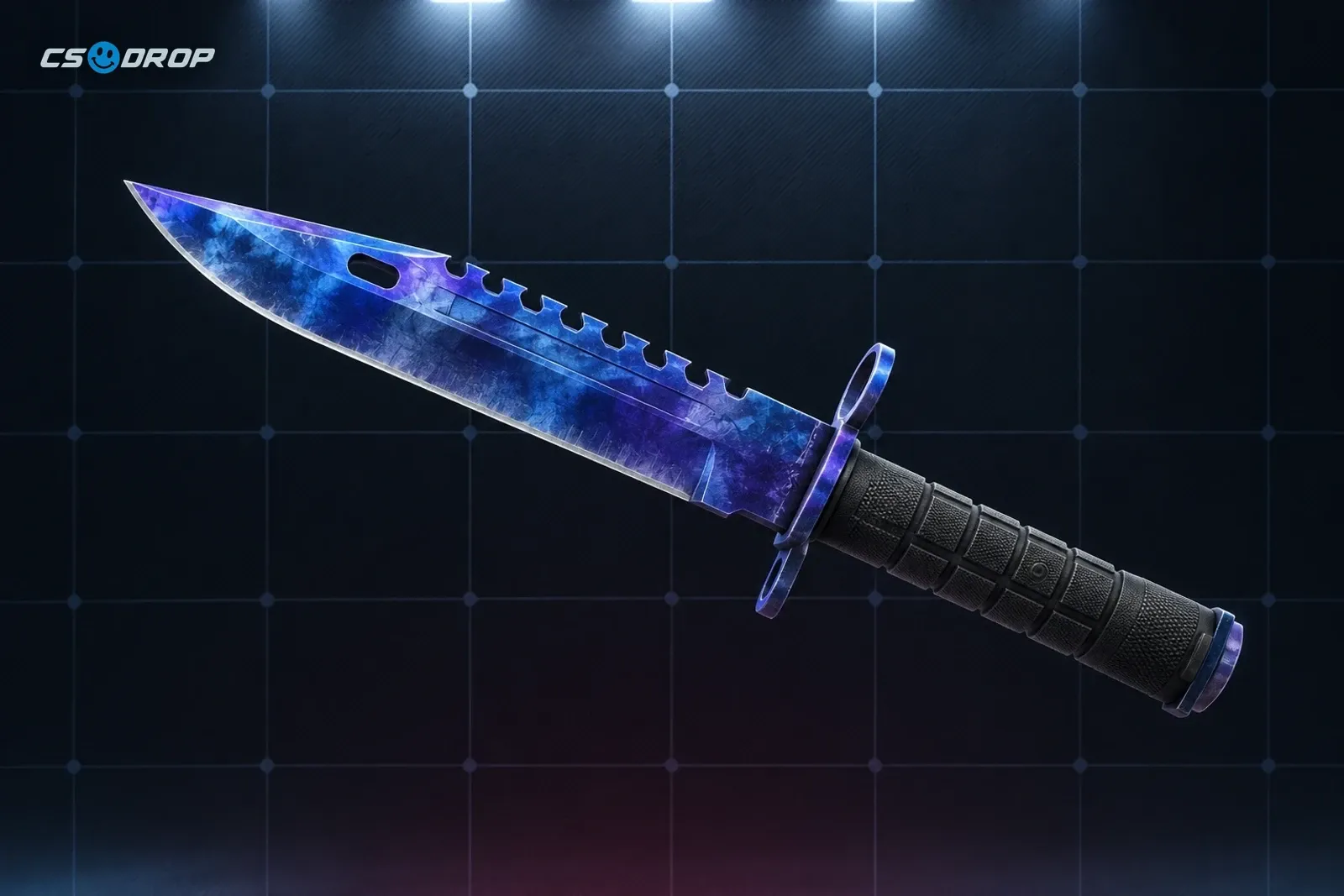
The 0.26% also covers the whole gold pool, not one knife. Different items of the same quality have the same chance to appear. A pool of 20 gold finishes (an illustrative number) gives each about 0.013%, before wear and pattern are rolled.
| Target | Chance per case | About 1 in | Cases for 50% |
|---|---|---|---|
| Any knife or gloves | 0.26% | 385 | 267 |
| StatTrak knife | 0.026% | 3,850 | 2,666 |
| One finish in a 20-item gold pool | 0.013% | 7,700 | 5,332 |
The disclosure is also slightly more precise than 0.26%. The Counter-Strike Wiki lists the Rare Special rate as 0.25575%. That moves "1 in 385" to about 1 in 391 and shifts each row of the main table by a few cases.
Do Terminals and Souvenir packages follow the same formula?
No. A Terminal isn't a blind roll, and Souvenir packages have no knife or glove slot. A Terminal shows you a random item and its price before you decide, and you can decline for a new offer up to five times. It needs no key.
The Genesis Collection, the first Terminal, was released on September 16, 2025. It has no gold-tier drops, so no knives or gloves. The Dead Hand Terminal followed on March 11, 2026, with 17 new skins and 22 new gloves. The Spike's guide covers the collection.
Because you see the item and price before paying, "cases until a knife" doesn't describe a Terminal. Souvenir packages are similar in that there are no knives or gloves as Souvenir items.
What does provably fair add to the maths?
It lets you verify that a result was fixed before you played. It does not make the odds generous. CSDROP's provably fair system uses HMAC-SHA256 with a server seed shown hashed before play, your client seed and a nonce. You can verify results from your game history. For case battles, the client seed comes from a future EOS blockchain block ID.
What it does not do:
- It doesn't change the drop rates or the house edge.
- It doesn't reduce variance. Fair rolls can still run cold for 1,000 cases.
- It doesn't tell you whether a case is good value. Read the displayed item pool and drop rates for that.
How do you keep case opening under control?
Case opening on CSDROP is real-money play for adults only: 18+, or the age of majority in your country if higher. Treat it as paid entertainment, not income.
- Set a budget before you start and stop when it's spent. Never top up to "win it back".
- Set a time limit, and never use money you need for rent, food or bills.
- Don't size a budget around "385 cases". That number guarantees nothing.
Tip: To see how an opening works before spending, try the free case; conditions are shown on the page. If it stops being fun, take a break.
FAQ
How many cases do you need to open to get a knife in CS2?
There is no fixed number. At 0.26%, you need about 267 cases for a 50% chance of at least one knife or gloves, 885 for 90% and 1,151 for 95%. "385 cases" is the average gap, which gives roughly a 63% chance.
Does 1 in 385 guarantee a knife after 385 cases?
No. After 385 openings about 37% of players still have no gold item. Each case is a fresh 0.26% roll, so the average is not a deadline.
What are the odds of a knife in 100 or 1,000 cases?
About 22.9% in 100 cases, which is 1 − (1 − 0.0026)^100. In 1,000 cases it's about 92.6%, so about 7.4% of players still hit none. A miss streak that long is rare but entirely normal for these odds.
Is there a pity timer in CS2 cases?
No. Every opening is independent, so a dry streak doesn't raise your chance and a lucky hit doesn't lower it. Your chance over a planned number of cases is cumulative, but your chance on the next single case is always the same.
How many cases for a StatTrak knife?
A StatTrak knife is about 0.026%, or roughly 1 in 3,850. You need about 2,666 openings for a 50% chance and about 8,855 for 90%. Gloves can't be StatTrak.
Are CSDROP case odds the same as Valve's 0.26%?
Not necessarily. The 0.26% is Valve's published rate for official weapon cases. Each case on CSDROP shows its own item pool and drop rates before you open it, so read the page for the case you want.


